
Overview of Project Progress
The DeepStor research initiative encompasses a sequence of meticulously choreographed tasks that are both scientifically and technically demanding. All measures, ranging from the establishment of hydrogeological monitoring infrastructure and detailed geophysical characterizations to the planned exploration drilling, are meticulously planned, documented, and evaluated on the basis of data. The objective of the research initiative is to document the characteristics of prospective deep storage formations on the KIT North Campus, and to methodically assess their suitability for high-temperature heat storage (HT-ATES). The subsequent section offers an overview of the present project status, significant milestones, and ongoing research activities.

Drilling operations started on September 13, 2026

Drilling operations for DeepStor-1 began in the late afternoon of Sunday, September 13, 2026. With mobilization and commissioning of the drilling rig completed, the project has now entered its central operational phase.
During drilling, the drill string and drill bit are gradually lowered into the subsurface and rotated. At the same time, drilling fluid circulates continuously through the drill string to the drill bit. There, it picks up the rock fragments generated during drilling and transports them back to the surface through the annulus between the drill string and the borehole wall.
At the surface, the returning drilling fluid is treated and separated from the entrained solids before being recirculated into the drilling-fluid system. The drilling fluid performs several functions, including supporting the transport of drill cuttings and contributing to borehole stability and safe well control.
As drilling progresses, additional operations will follow, including the sectional stabilization and casing of the borehole, as well as scientific investigations and measurements. The drilling rig is designed for a range of operations, including raising and lowering the drill string and casing, rotating the drill string, and conditioning and circulating the drilling fluid. The rock samples and measurement data obtained during drilling will provide the basis for further scientific characterization of the deep subsurface and assessment of its potential.
Final preparations for the start of drilling are underway
Over the past several days, assembly of the drilling rig for the scientific exploration well has continued. Key components of the drilling and drilling-fluid systems have been installed and connected. These include the drilling-fluid treatment system, pump and piping connections, as well as equipment for solids separation and processing.
The drilling rig assembled over the past few weeks forms the technical core of the upcoming exploration activities. Due to the planned drilling depth and the associated technical requirements, the equipment must be capable of handling high loads and safely managing heavy drilling and completion components.
The image on the right shows the sealed rig cellar beneath the drilling rig. The conductor pipe installed during the winter protrudes from the center.

Drilling rig mobilization begins on August 17, 2026

On August 17, 2026, the drilling contractor Daldrup will begin mobilizing the drilling rig at KIT Campus North. During this phase, the rig and the required technical infrastructure will be delivered and assembled. Drilling operations for the DeepStor-1 well are currently scheduled to begin on August 31, 2026.
The exploration well is primarily intended for the scientific investigation of the deep subsurface. Unlike production wells, its purpose is not long-term extraction but the acquisition of geological, geophysical, petrophysical, and geochemical in situ data. This includes the analysis of drill cores, drill cuttings, and drilling fluid, as well as geophysical borehole logging.
The results will provide information on the geological structure, rock properties, temperature and stress conditions, potential fluid movement, and the drillability of the subsurface formations. The data obtained will form an important basis for evaluating potential geothermal storage horizons and for further scientific investigations within the DeepStor project.
Drilling operations are expected to take approximately three months. During this period, increased delivery and heavy-vehicle traffic may occur. The DeepStor team and Daldrup are coordinating their activities carefully to minimize disruptions to campus operations.
Your contacts:
- Acting Project Manager: Dr. Emmanuel Gaucher – emmanuel.gaucher∂kit.edu
- Drilling Manager: Said Kamrani-Mehni – said∂kamrani-profound.com
- Project Communications: Dr. Judith Bremer – judith.bremer∂kit.edu
- Seismic Monitoring: Dr. Jérôme Azzola – jerome.azzola∂kit.edu
Further expansion of the drill site infrastructure
Another important milestone in the preparation of the DeepStor exploration well was reached in calendar week 24. The planned rig cellars were successfully positioned and installed.
The rig cellars are an important component of the drill site infrastructure. They provide secure accommodation for well components and help protect the installation during drilling operations. The rig cellars were installed in the area of the well entry point. At this location, excess drilling fluid and cement slurry can be collected in a controlled manner, and parts of the safety equipment can be accommodated if required. After completion of the drilling operations, the cellar structure can be used to house the wellhead.

DeepStor drilling site construction activities

On Monday, May 18, 2026, construction activities will commence at the drilling site to establish the necessary technical infrastructure. These measures form the basis for the planned exploration drilling operation. In preparation, the contracted construction company Schleith will begin mobilization activities on site, including the delivery of materials and equipment as well as the setup of the construction area.
According to the current project schedule, the exploration drilling itself is expected to begin in mid-August 2026. The objective of the drilling operation is the detailed investigation of potential subsurface storage formations and the acquisition of data for evaluating their suitability for geothermal thermal energy storage.
We will continue to provide updates on the further progress of the project, including detailed schedules and potential impacts.
Completion of Conductor Pipe Installation
Following a brief delay due to subsurface conditions, the installation of the conductor pipes was successfully completed on Monday, January 19, 2026. With the completion of these preparatory measures, a key technical milestone has been reached for the continued implementation of the DeepStor exploration drilling.
We would like to thank everyone involved for their understanding and patience.

Performing the Conductor Pipe Installation
As part of the preparations for the DeepStor exploration drilling, the service provider Wagenborg Foxdrill is currently installing the conductor pipes. The implementation of these large-diameter steel pipes is crucial for stabilizing the upper section of the borehole, ensuring the protection of groundwater and facilitating the safe execution of subsequent drilling operations. The hydraulic impact hammer driving method is an environmentally friendly installation technique that offers an efficient alternative to conventional drilling and cementing methods.
The conductor pipes are made from standard-compliant steel pipes and installed in individual sections, ensuring precise alignment and safety. The individual pipe segments are positioned on site, precisely aligned, and extended using full-penetration welded connections. A dedicated guidance system with roller guides is used to ensure vertical alignment. Geometric control is maintained through the implementation of surveying techniques.
The selected driving method is characterized by a short construction period, minimal site preparation, and effective hydraulic sealing between the pipe and the surrounding soil. The construction activities are scheduled to commence in mid-January 2026. During the installation process, there is a possibility that temporary elevated noise levels and ground vibrations may be experienced. However, these effects are time-limited and are closely monitored as part of the project's comprehensive monitoring program.


Preparation for Setting the Conductor Pipes

Preparatory work for the installation of the conductor pipes is currently underway. These measures establish the technical and logistical prerequisites for the subsequent ram drilling operations.
Establishing a Groundwater Monitoring Network
As part of the preparations for the DeepStor exploration drilling project, new wells are currently being installed to ensure the protection of the groundwater (November/December 2025). These wells are a key component of the project's comprehensive environmental and safety strategy. Continuous monitoring of local groundwater conditions allows for the early detection and assessment of changes.
The establishment and operation of a groundwater monitoring system with seven monitoring wells is planned. Following the completion of the project, hydraulic tests will be conducted and groundwater samples will be collected. These samples will be used to determine the natural baseline composition of the intercepted groundwater, also known as the baseline measurement. Initial analyses will be performed by a testing laboratory accredited in accordance with DIN EN ISO/IEC 17025 to ensure high data quality and comparability. For ongoing monitoring, sensors will be installed within the screened intervals of the wells. These sensors will record parameters such as temperature and electrical conductivity. These parameters will be used as indicators of potential inputs. In addition, regular sampling and analytical campaigns will be carried out to reliably document any changes.
Approval of the groundwater monitoring concept was granted through a separate water-law permitting procedure. This approach ensures that all measures comply with scientific and regulatory requirements while simultaneously establishing a robust data basis for the further development of the DeepStor project.


The DeepStor-1 main operating plan has been approved
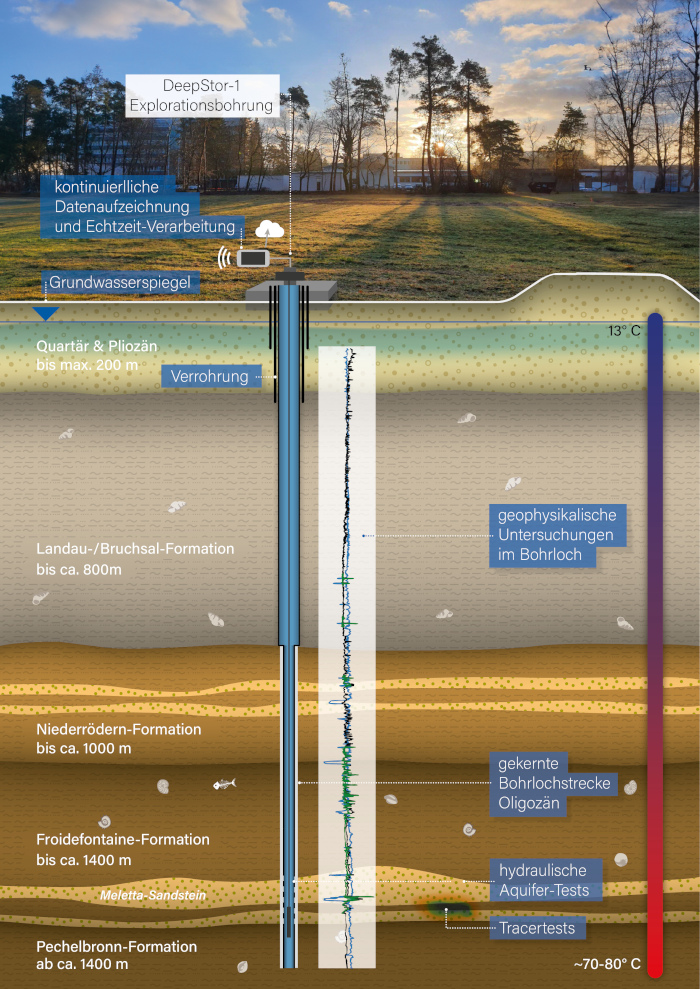
At the North Campus of the Karlsruhe Institute of Technology (KIT), the approval of the primary operating plan for the DeepStor-1 exploration well has established the foundation for the subsequent development of contemporary geothermal heat storage technologies. The objective of the DeepStor project is to investigate the effective storage of surplus heat from summer months in deep subterranean reservoirs and its subsequent utilization during winter months in a manner that is environmentally sustainable. The basis for this will initially be provided by data from a borehole around 1,400 meters deep on the North Campus, from which around 700 meters of rock will be extracted as drill cores and then examined. The analysis of these drill cores will provide information about the properties of the various geological formations.
The subsequent phases of the project entail site preparation, the initiation of peripheral construction in fall 2025, and the installation of conductor pipes to safeguard the groundwater. The drilling is scheduled to commence in the second quarter of 2026. The implementation of close seismic monitoring, which utilizes seismometers, vibration meters, Raspberry Shakes, and fiber optic DAS, has been demonstrated to enhance safety and transparency. A traffic light system has been developed to ensure that unusual ground vibrations are immediately detected, evaluated, and communicated.
.